8 Principles of Enterprise Performance Management

This is a list of what most of my clients tell me they want.  I propose that this list is exactly what EPM delivers.

So unless I hear otherwise, these are the 8 principles of enterprise performance management:

  1. We have a lot of data, we’re getting more every minute, and we want to use it to compete better;8 robots
  2. To use all that data, we want to gather it and transform it so that it makes sense;
  3. We want new insights into our business, based on the facts gleaned from the data;
  4. We want to know what levels of performance are possible in our industry, for our business, in the future; Read more of this post

Enterprise Planning

There are many kinds of plans in any organization. The kind of plan depends on what the plan is trying to accomplish, who the audience is, and how frequent and granular the plan needs to be. Here are the most common types of EPM plans:

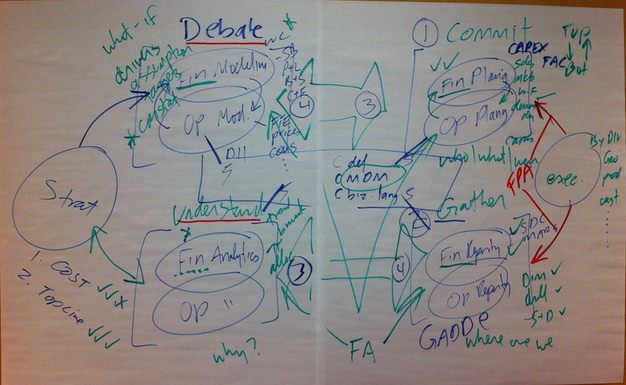
paper whiteboard
Strategic Planning

  • Annual budget
  • Long-range plan/strat plan
  • Cash-flow forecast
  • Balance sheet plan

Finance Planning

CFO and CIO join forces to serve “The Business”

Organizations that have implemented Performance Management more broadly are nearly four times more likely to be among the most competitive organizations in their industry.

—Brian McDonough, Research Manager, Analytics and Data Warehousing Software, IDC, Financial Performance and Strategy Management Survey of Buyer Priorities for 2011, Doc #226261, Dec. 2010

Harvard Business Review advocates that business and IT shouldn’t just be aligned, they should be ‘‘forged together.’’  (David M. Upton and Bradley R. Staats, ‘‘Radically Simple IT,’’ Harvard Business Review, March 2008.)  One way HBR says you can do this is by having the CIO report directly to the CEO or COO, not the CFO. While I have seen this reporting structure in many of our client organizations, it does not automatically mean that IT and the business are forged together, or even aligned for that matter. Certainly the business analyst (BA) role has done much for crossing the chasm, in both directions, for IT and the business. And where I see the most successful financial systems implementations are where there the finance/information systems (IS) role acts as the BA. But this is still not a guarantee for a meeting of the minds between business and IT.

2 way arrows

Photo © Ruth Dimon, 2013

I propose five ‘‘better’’ practices for closer IT/business alignment based on my client engagements over the last 30 years: Read more of this post

Closing the Strategy-Execution gap

In March 2010, Harvard Business Review surveyed

Photo © Ruth Dimon, 2013

Photo © Ruth Dimon, 2013

1,075 readers about strategy and execution in their organizations.
Only 37% said their companies are ‘‘very good’’ or ‘‘excellent’’ at execution.

What is it that keeps us from having a sustainable process for executing our strategy?
On the one hand you have your strategic objectives, including:

  • Profitable Revenue Growth
  • Customer Success
  • Operational Efficiency
  • Employee Engagement
  • Cash cycle velocity
  • And so on.

On the other hand you have available resources at your disposal:

Information Qualities

© Ruth Dimon, 2013

Photo © Ruth Dimon, 2013

When thinking about turning data into information, you have to consider all of the different qualities of that information. The following list is not exhaustive, but it’s more complete than we usually get when planning how and when (and where) we gather our data and transform it into something people can use.

This list is especially useful when designing business intelligence systems and planning on how to gather data and turn it into useable information.

Business Qualities of Information

Answering Business Questions

Photo © Ruth Dimon, 2013

Photo © Ruth Dimon, 2013

Businesses have a ton of information.  The usual starting place for trying to understand all that information is a desire to answer a business question.
There are, at least, four foundational questions:

  1. Where are we right now compared to where we said we would be?
  2. Why did we get what we got? What happened to give us those results?
  3. What do we want to happen? What is possible in our industry, in this economy? And what’s next?
  4. How will we get it done?Who will do what, and by when?

These questions help us align our strategy, objectives, and initiatives with our intended results. They help challenge our objectives and help generate and reveal our assumptions, constraints, and value drivers. The answers to these questions should Read more of this post

“DRiVE” Driven *

DRiVEI’m a fan of Dan Pink‘s work and had the good fortune to meet with him recently at 30,000 ft between Chicago and DC.  He was generous enough to give me some advice about my own book and promoting the ideas of Enterprise Performance Management.  Luckily, I referenced Dan’s work “Drive:The Surprising Truth About What Motivates Us, ” in both the preface and in Chapter 9 of my book.  There is an entire dimension of Enterprise Performance Management as a structure or platform for fulfilling what motivates us that I’m compelled to write more about it.  Here is my thinking at the 30,000 ft level:

Autonomy – the desire to direct our own lives.
If we know what the strategy is, and what the corresponding strategic objectives and targets are, why can’t we direct our piece of the business, in concert with everyone else’s pieces of the  business, to achieve those objectives?  EPM ingredients include:

  • Accountability for the results
  • Independence to make fact-based decisions to deliver those results
  • “My” slice of the business (P&L by ‘x’ where x can be customer, cutomer-type, product, channel, territory, market, and so on)
  • More facts, less politics

Mastery – the urge to get better and better at something that matters.
Maybe what matters to you is Read more of this post

Enrolling others in the possibility of EPM

I just blogged a bit more about the purpose of my book over here at the CheckPoint Consulting blog – check it out!

Book Press Release


Here’s the CheckPoint Consulting press release about my book.un grand coup

And I noticed amazon.com said they only had 2 copies left in stock (more on the way).  That’s encouraging!  Unless they only ordered 10 to begin with 🙂


What really constrains your performance?

Financial and operational planning processes, typically go like this: set targets, apportion the targets to different parts of the business, and then each part of the business further assigns a portion of the target down through their ranks.  Targets are usually set at the top (the board and the senior leadership team) and are usually derived using prior year performance plus a growth factor that’s been vetted by economic, market, and competitive models.  The apportionment can be done by geography (since North America delivered 60% of last year’s results, they get 60% of the targets this year), by product line (the WidgetMaster 5000 accounted for half of our sales, so it gets half of the goal for this year), by headcount, or some combination thereof.

The “ranks” receive their granular targets and sometimes get to negotiate their allotment and sometimes they don’t.  In a ‘top down’ plan, the likelihood of negotiating is low.  Some plans are created from the bottom up: each of the “ranks” looks at their patch and assess what they thing is possible and then all those assessments are consolidated (by geography, or product line, or combination) until you get the top-of-the-house target.  At that point, senior management pulls out the economic, market, and competitive models and compares it to the consolidated plan and then challenges the ranks to stretch what they think is possible and commit to a higher number than they came up with.

Enlightened organizations Read more of this post